Class action claims rates: why most class members never file, and what moves the number
The typical consumer class action claims rate was 9% (median) in FTC data. How notice format, reminders and claim forms move it, and what courts ask firms to report.
In what the FTC called "the most comprehensive empirical study of consumer class action settlements to date," the median class action claims rate was 9% and the weighted mean was 4%, counting claims against the people who received direct notice (FTC staff report, September 2019). Rates moved most with the notice itself. Mailed notice packets with a claim form did best, email did worst, and cases with a second notice had roughly double the median.
- Two federal studies, measured differently, land close together: a 9% median in the FTC's consumer sample and 8% in the CFPB's 2015 study of consumer finance settlements.
- Format matters. FTC median claims rates were 16% for notice packets, 7% for postcards and 2% for email.
- Repetition matters. Two or more notice attempts went with a 17% median, against 8% for one.
- Payout size and publication notice showed no meaningful link to claims rates. Plain-English payment language did.
- Rule 23's 2018 committee note and N.D. Cal.'s guidance contemplate an expected claim rate up front and actual results at the end.
What is the average class action claims rate?
A claims rate is the share of class members who file a claim. The FTC calculated it as claims filed divided by direct notice recipients, using data subpoenaed from seven large administrators for 149 consumer cases, mostly each administrator's ten largest settlements in 2013, 2014 and 2015 (FTC staff report, September 2019, pp. 12 to 13).
Across cases that required a claim, the median was 9% and the weighted mean was 4% (Table 2, p. 21). The middle half of cases ran from 3% to 19%. In the bottom tenth, at most 2% of recipients filed; in the top tenth, at least 34% did.
The weighted mean counts each case by its number of recipients, so a few giant campaigns pull it down. The median is usually the better comparison for a single case.
The CFPB found nearly the same median, 8%, across the 105 of its 419 consumer finance settlements with usable data, measured against estimated class size. Its unweighted average was 21%, and its weighted average was 4% with one very large TransUnion settlement included and 11% without it (CFPB Arbitration Study, March 2015, Section 8, p. 30). The CFPB calls these floors, because final claim counts were often missing from court files.
Both datasets are older than they look. The CFPB's settlements were approved from 2008 to 2012, and the FTC's cases mostly date to 2013 to 2015. Recent comparables from your administrator may be closer to your case.
At the high end, Judge James Donato's final approval order in the $650 million Facebook biometric privacy settlement counted 1,571,608 timely claim forms as of December 14, 2020. Using a 6.9 million class estimate, that was a claims rate of around 22% (against the roughly 9.4 million names on the notice list, it would be near 17%). The court called it "a result that vastly exceeds the rate of 4-9% that is typical for consumer class actions" (In re Facebook Biometric Information Privacy Litigation, N.D. Cal., Feb. 26, 2021).
Which notice method gets the highest claims rate?
This table pulls the FTC's results by notice approach into one place. Rates are percentages of direct notice recipients, excluding 8 cases with calculated rates above 100%, as the report does.
| Notice approach | Median claims rate | Weighted mean | Cases |
|---|---|---|---|
| All cases requiring a claim | 9% | 4% | 116 |
| Notice packet (any mailed notice other than a postcard) | 16% | 10% | 55 |
| Notice packet with claim form | 18% | 11% | 52 |
| Notice packet without claim form | 4% | 2% | 3 |
| Postcard | 7% | 6% | 22 |
| Postcard with detachable claim form | 12% | 10% | 8 |
Source: FTC staff report, September 2019, Figures 5 and 6 (pp. 25, 27) and Table 3 (p. 28). Counts for the last five rows are from Figure 5. The report's text on p. 25 reverses the email mean and median; the table follows the figure.
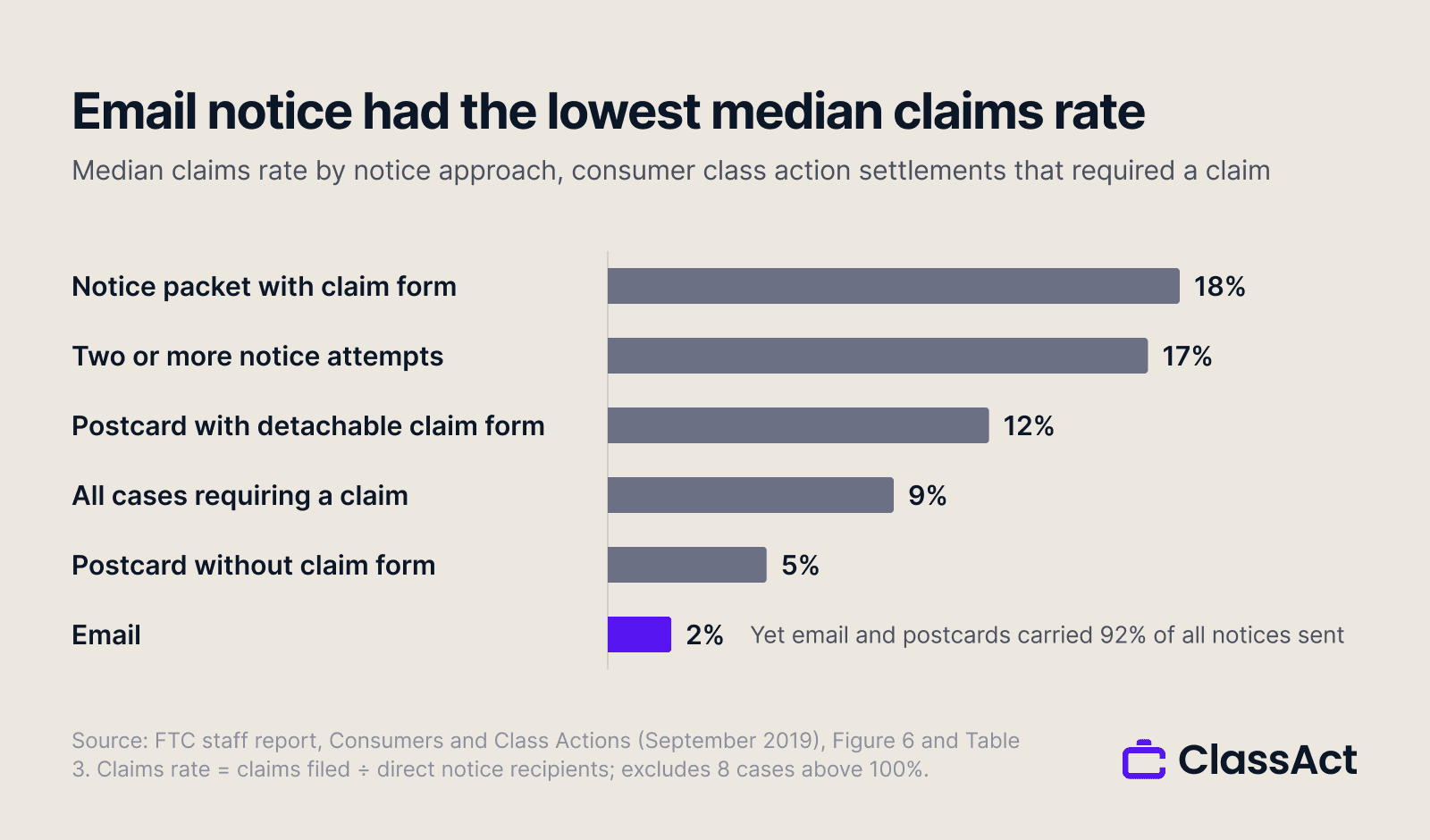
Holding other factors constant, email was linked to a claims rate 7.3 percentage points lower than notice packets, and two or more rounds of notice to one 5.7 points higher; the postcard gap wasn't significant (Table 7, p. 41). The FTC calls these associations, not causes. A packet campaign may also mean better addresses.
The report suggests one reason email lags. In 10 cases with open data, 14% of attempted email notices were opened, and in 4 cases with click data, 4% drew a click (Table 5, p. 30). Delivery wasn't the gap: undeliverable rates were 15% for email and 12% for mail (Table 4, p. 29). Yet emails and postcards carried 92% of all notices in the sample, since the largest cases were the most likely to use them.
Supplemental publication showed no significant relationship with claims rates (p. 11). The Federal Judicial Center's checklist for judges is blunter about plans built on online ads alone: "Reach, awareness, and claims will likely be very low when such a program is complete" (FJC Judges' Class Action Notice and Claims Process Checklist, 2010, p. 4).
Does a bigger payout lead to more claims?
Less than you'd expect. Weighted claims rates were 6% for FTC cases with a median payment under $10, 10% at $100 to $200 and 7% over $200 (Figure 9, p. 33). The FTC said the gap between the under-$10 and $100 to $200 groups was statistically significant but "only 4 percentage points," and its regression found no significant link overall (pp. 32 to 33). Bigger payments did go with higher check cashing: in direct payment cases, 39% of checks were cashed under $10 and 75% to 83% above $50 (Figure 8, p. 32).
One likely reason is that people can't respond to a number they never see. About a third of the notices the FTC reviewed gave no compensation estimate (p. 32). While 94% of cases paid cash, only 40% used plain-English payment language such as "payment," "refund" or a dollar figure (p. 35). Notices that did had claims rates about 10 percentage points higher, holding other factors constant (pp. 42 to 43).
Interviews with five administrators in the CFPB study add nuance. Most felt the amount mattered, and one reported rates of 2% to 6% for $25 claims, 5% to 10% for $100 claims and 8% to 15% for $500 claims, leveling off after $500 (CFPB, Section 8, p. 31 and n.51).
How much does the claim form matter?
Putting the form in the mailing lines up with higher rates in the FTC data, though the samples are small. Postcards with a detachable claim form had a 12% median, against 5% without one (Table 3, p. 28). The three notice packets sent without a form had a 4% median.
On proof requirements, the two federal studies point the same way with different confidence. The FTC found no significant link between claims rates and form length or documentation overall (p. 12), but its forms were mostly simple: 54% were one page, and only 5% asked for "very difficult" items such as original receipts or notarization (Table 6, p. 39). Those few forms had claims rates 27.3 percentage points lower, a result the FTC calls only marginally significant (n. 61). Administrators interviewed by the CFPB reported that "claims rates fell nearly 90% if documentary proof was required," and that "an online process, combined with mail claims, increases rates by 5-10% compared to a mail-only process" (CFPB, Section 8, p. 31).
The FJC checklist asks judges: "Are the claim form questions reasonable, and are the proofs sought readily available to the class member?" It warns that a low claims rate caused by unreasonable proof requirements can make a fairness decision "overstate the value of the settlement to the class" (FJC checklist, p. 6).
The Facebook order shows the low-friction version. The claim form "was easy to complete online or by mail," required basic account information, and offered four payment options: paper check, Zelle, PayPal or direct deposit. Notice also ran through Facebook itself (order, p. 4).
Easy claiming has a cost side. The same FJC checklist asks whether there are "sufficient safeguards in place to deter waste, fraud, and/or abuse" (p. 7), so ask the administrator how it screens claims before relying on an older approval rate.
What do courts ask about claims rates?
The 2018 amendments to Federal Rule of Civil Procedure 23, effective December 1, 2018 (Supreme Court order), address claims in the rule and its Advisory Committee Note (Rule 23 and notes, Cornell LII):
- Rule 23(c)(2)(B): "The notice may be by one or more of the following: United States mail, electronic means, or other appropriate means."
- Rule 23(e)(2)(C)(ii): approval considers "the effectiveness of any proposed method of distributing relief to the class, including the method of processing class-member claims."
- Note on (e)(1): the showing before notice goes out "may include details of the contemplated claims process and the anticipated rate of claims by class members." It also mentions deferring fees "until the court is advised of the actual claims rate and results."
- Note on (e)(2): "A claims processing method should deter or defeat unjustified claims, but the court should be alert to whether the claims process is unduly demanding."
The Northern District of California's Procedural Guidance for Class Action Settlements (last modified September 5, 2024) gets specific. With a claim form, it asks for "an estimate of the expected claim rate in light of the experience of the selected claims administrator and/or counsel based on comparable settlements," plus "the number and percentage of claim forms submitted" in at least one comparable settlement. Within 21 days after checks go stale, a post-distribution accounting covers claims, each notice and payment method's success (if known) and "the number and value of checks not cashed."
Other districts and judges differ, and the guidance itself defers to the presiding judge's orders. Check the local rules and standing orders in your court.
Rule 23 hasn't changed since 2018, and the Rule 23 ideas on the Advisory Committee on Civil Rules' October 21, 2026 agenda don't touch notice or claims (agenda book, p. 168).
How can you estimate a claims rate before settlement?
Here's a worksheet. Fill in your own numbers; the only benchmarks are the federal figures above.
- Direct notice recipients (R): class members you can reach individually, after address updates.
- Expected claims rate (C): from comparables that match your notice format and contact data quality.
- Expected claims: R × C.
- Approved claims: expected claims × approval rate. The FTC's weighted mean approval rate was 86% (median 93%) (Table 2, p. 21).
- Pro rata payment per approved claimant: net settlement fund ÷ approved claims.
- Fixed-amount structure instead: total paid = approved claims × per-claim amount.
Worked example: 500,000 direct notice recipients, a $5,000,000 net fund, 86% approval.
| Claims rate | Claims filed | Approved claims | Pro rata payment each |
|---|---|---|---|
| 2% (FTC email median) | 10,000 | 8,600 | $581.40 |
| 4% (FTC weighted mean) | 20,000 | 17,200 | $290.70 |
| 9% (FTC median) | 45,000 | 38,700 | $129.20 |
| 16% (FTC notice packet median) | 80,000 | 68,800 | $72.67 |
In a pro rata fund with no reversion, the whole net fund goes out at any of these rates; what changes is how many class members get paid. At a fixed $50 per approved claim, the same settlement would pay $860,000 at 4% and $3,440,000 at 16%, with the rest following the agreement's terms. N.D. Cal. asks parties to explain any reversion "in light of Ninth Circuit case law disfavoring reversions."
What this means for your firm
None of this is a legal requirement. These are levers the data points to.
- Ask whether a claims process is needed. It's the FJC checklist's first claims question, and it favors direct payment when the defendant already holds the data.
- Send the form with the notice, and offer online filing. Postcards with a detachable form had about twice the claims rate of those without.
- Budget for a second touch. In the FTC sample, the second notice was typically a reminder to people who hadn't filed.
- Say "payment" plainly, with an amount or estimate where the structure allows. In the FTC's analysis, the only notice characteristics significantly related to claims rates involved payment language.
- Ask only for proof people keep. Administrators told the CFPB that proof requirements cut claims sharply, and the committee note warns against a process that is "unduly demanding."
- Get the delivery data. Ask the administrator for undeliverable, open and click rates and a re-mailing plan.
- Start with clean contact data. Contact details gathered during an investigation go stale, and the FJC checklist asks for address updates before mailing.
- Put a number on the expected rate early, then track the actual one. The committee note and N.D. Cal.'s guidance contemplate both.
FAQ
There's no official benchmark. Federal data puts the typical consumer settlement at a 9% median and 4% weighted mean (FTC, 2019), and consumer finance settlements at an 8% median (CFPB, 2015). A 2021 N.D. Cal. order, citing the FTC figures, called 4% to 9% typical. Compare against settlements with similar notice methods and contact data.
In the FTC's data, attention and understanding look like bigger obstacles than payout size. In its online panel study (not a probability sample), 38.2% of respondents correctly understood what a class action email was from the inbox view, and 40.5% understood the steps to get a refund. In email cases with open data, about 14% of attempted notices were opened.
Not in the FTC's data. Email campaigns had a 2% median claims rate, against 7% for postcards and 16% for notice packets. The FJC checklist says postal mailing addresses are "generally more effective than e-mail in reaching class members." Rule 23(c)(2)(B) has listed "electronic means" as a notice option since December 1, 2018.
The FTC found no significant relationship between adding publication notice and the claims rate, and said rates for publication cases are likely overstated, since people who saw only the publication aren't in the denominator. The FJC checklist warns that plans relying on internet ads alone tend to produce very low claims.
It depends on the agreement. In a pro rata fund, unclaimed shares go to other claimants, up to any caps. Money still left over, such as uncashed checks, may be redistributed, sent to a cy pres recipient or, under some agreements, returned to the defendant. The 2018 Rule 23 committee note says that because some funds are frequently left unclaimed, the agreement "ordinarily should address the distribution of those funds."
Sources
- Federal Trade Commission staff, Consumers and Class Actions: A Retrospective and Analysis of Settlement Campaigns, September 2019
- Consumer Financial Protection Bureau, Arbitration Study: Report to Congress, March 2015, Section 8
- Federal Judicial Center, Judges' Class Action Notice and Claims Process Checklist and Plain Language Guide, 2010
- Federal Rule of Civil Procedure 23 and Advisory Committee Notes (Cornell LII), 2018 amendments effective December 1, 2018
- Supreme Court order adopting the 2018 amendments to Federal Rule of Civil Procedure 23, April 26, 2018
- U.S. District Court for the Northern District of California, Procedural Guidance for Class Action Settlements, published November 1, 2018, last modified September 5, 2024
- In re Facebook Biometric Information Privacy Litigation, No. 15-cv-03747-JD, Dkt. 537 (N.D. Cal. Feb. 26, 2021), order re final approval
- Advisory Committee on Civil Rules, agenda book for the October 21, 2026 meeting (Rule 23 items, p. 168)
ClassAct is a technology platform, not a law firm. This post is general information, not legal advice.