How long is the typical data breach notification delay? What Washington's AG data shows
Our analysis of Washington's open breach dataset: the median gap from incident awareness to AG notice hit 100 days in 2026, smaller breaches took longest, and public portals differ widely.
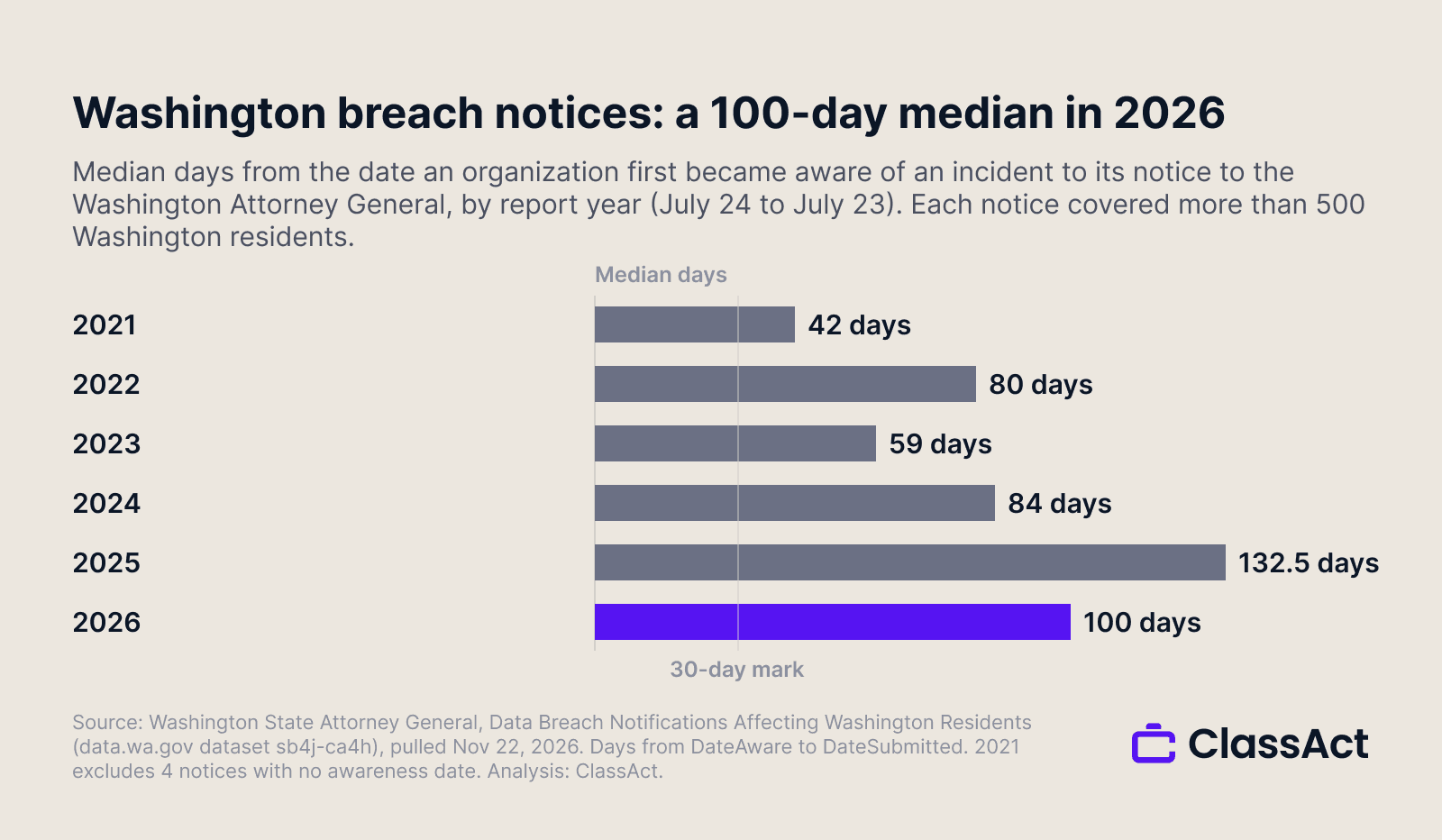
In Washington, the median data breach notification delay was 100 days in the year ended July 23, 2026: the median gap between the date an organization said it first became aware of an incident and the date its notice reached the state Attorney General. That's down from 132.5 days the year before and up from 42 in 2021, in our analysis of the AG's open dataset. Of 197 notices, 173 (88%) arrived more than 30 days after the awareness date, but the statute's 30 days run from discovery of the breach, which the data doesn't record, so this isn't a count of late filings.
- Washington's Attorney General logged 197 data breaches and 3,529,112 notices to residents in the year ended July 23, 2026, per its November 9 report.
- In the AG's open dataset, the median gap from an organization's first awareness of an incident to its AG notice was 100 days in 2026, down from 132.5 in 2025 and up from 42 in 2021.
- 173 of 197 notices in 2026 came more than 30 days after the awareness date, but the statute's 30 days run from discovery, which the data doesn't record.
- Smaller breaches took longest: a median of 156.5 days for notices covering 500 to 999 residents, versus 59 days at 50,000 or more.
- California's list shows no counts, Texas listings can come down within a year, and Maine's public database was offline as of November 22, 2026.
The AG's 2026 Data Breach Report, released November 9, 2026, gives the totals. The notification dataset behind it gives the dates for each notice since 2015.
What does Washington's 2026 data breach report show?
The report covers notices the AG received from July 24, 2025 to July 23, 2026. The AG receives notices for breaches affecting more than 500 Washington residents.
- 197 breaches, down from 212 the year before. It's still the fourth highest total since 2016.
- 3,529,112 notices sent to Washington residents, below the state's ten-year average of about 4.8 million a year.
- 139 cyberattacks, 85 of them ransomware. Ransomware was 61% of cyberattacks and the most common method for the sixth straight year.
- Social Security numbers in 148 breaches, just over 75%. Full date of birth appeared in 156, which the report calls the most compromised piece of personal information.
- 14 breaches over 50,000 Washingtonians and none of 1 million or more. It's the first full year without a mega breach since 2023.
The report asks the Legislature to add data types such as ITINs and precise geolocation to the definition of personal information, to require reasonable security procedures, and to require notice when "an AI agent operated by the entity gains unauthorized access" to personal information. The 2024 report recommended cutting the notification deadline to three days. Neither the 2025 nor the 2026 recommendations repeat it.
How long is the data breach notification delay in Washington's data?
Nearly every row in the AG's dataset (all but 23 of 1,710) has a DateAware and a DateSubmitted. The dataset defines DateAware as the date the entity "became aware that a breach impacting Washington residents had occurred." The AG's online notice form asks for it this way: "When did the entity first become aware an incident took place." DateSubmitted is the date the notice reached the AG.
We measured the days between those two dates for every notice in report years 2021 to 2026, the six full report years since the 2019 amendments took effect on March 1, 2020. Those amendments cut the deadline for notifying residents from 45 days to 30. Report years run July 24 to July 23.
| Report year | Notices | Median days | Middle half of notices | Over 30 days | Over 90 days |
|---|---|---|---|---|---|
| 2021 | 282 | 42 | 29 to 94 days | 65% | 27% |
| 2022 | 159 | 80 | 44 to 166 days | 87% | 45% |
| 2023 | 181 | 59 | 34 to 145 days | 80% | 39% |
| 2024 | 294 | 84 | 49 to 175 days | 93% | 46% |
| 2025 | 212 | 132.5 | 58 to 222 days | 88% | 62% |
| 2026 | 197 | 100 | 54 to 219 days | 88% | 57% |
Source: Washington AG dataset sb4j-ca4h, pulled November 22, 2026 (last updated November 21, 2026). Days run from DateAware to DateSubmitted. 2021 excludes 4 notices with no awareness date. Dataset totals can differ slightly from the report's because the AG updates filings.
A worked example: at the 2026 median, an organization that first noticed an incident on January 5, 2026 would have notified the AG on April 15. The slowest quarter of 2026 notices took 219 days or more, and the longest took 758.
Awareness itself came quickly. Among 2026 notices with a breach start date (185), the median time from start to awareness was 4 days, and 148 of the 197 breaches were found while still in progress. Notices filed since the report period closed (77 through November 14, 2026) show a similar median, 101 days.
What does Washington law say about timing, and what can't the data show?
RCW 19.255.010(7) says an organization notifying more than 500 Washington residents "shall notify the attorney general of the breach no more than thirty days after the breach was discovered." The same section, at (7)(b), requires the AG notice to be updated if required information is unknown when the notice is due.
Subsection (8) says consumer notice "must be made in the most expedient time possible, without unreasonable delay, and no more than thirty calendar days after the breach was discovered." It makes exceptions for a delay requested by law enforcement and a delay "due to any measures necessary to determine the scope of the breach and restore the reasonable integrity of the data system." The current text of the section comes from the 2019 amendments (2019 c 241).
The dataset can't show:
- Why a notice came when it did. There's no field for a law enforcement delay or an updated filing.
- When the breach was "discovered" in the statute's sense. First awareness of an incident can come before an organization knows personal information was taken.
- When consumers got their letters. The form asks for the "Date notice provided," but the public dataset doesn't include it.
So the gap measures reporting time across filings, not whether any notice was late.
Which breaches take longest to reach the AG?
Small ones. In 2026, 152 of 197 notices (77%) covered fewer than 10,000 Washingtonians, and the median notice covered 2,093. Those smaller filings also took longer.
| Washingtonians affected | Notices in 2026 | Median days, awareness to AG notice |
|---|---|---|
| 500 to 999 | 54 | 156.5 |
| 1,000 to 9,999 | 98 | 99 |
| 10,000 to 49,999 | 30 | 84.5 |
| 50,000 or more | 15 | 59 |
Source: Washington AG dataset sb4j-ca4h, pulled November 22, 2026. The live dataset, last updated November 21, shows 15 breaches over 50,000; the November 9 report shows 14.
Which public breach portals show what?
Of the five public sources below, only Washington's publishes awareness dates. Thresholds, fields and clock triggers all differ.
| Source | Who reports, and when | What the public list shows | Watch for |
|---|---|---|---|
| Washington AG | More than 500 residents; within 30 days after the breach was discovered | Date reported, organization, date of breach, residents affected, information compromised, notice letter; open dataset with awareness, start, end and submission dates | Counts are notices, not unique people |
| California AG | More than 500 residents; a sample copy of the notice goes to the AG | Organization, dates of breach, reported date, sample notice; CSV download | No counts or data types; check the current statute for timing |
| Texas AG | At least 250 residents; within 30 days after the person "determines that the breach occurred" | Entity and address, types of information, Texans affected, whether and how consumers were notified, date published | Details may change; a listing can come down within a year if no further breach is reported |
| HHS Office for Civil Rights | HIPAA covered entities, 500 or more individuals; at the same time as individual notice, due "without unreasonable delay and in no case later than 60 calendar days after discovery" | Covered entity, state, entity type, individuals affected, submission date, type of breach, location of information, business associate present | No discovery date; HIPAA breaches only (a separate list covers 42 CFR Part 2 records) |
| Maine AG | When resident notice is required, unless the entity is regulated by Maine's Department of Professional and Financial Regulation; residents within 30 days after the person "becomes aware of a breach of security and identifies its scope" | Public database offline as of November 22, 2026; archive covers August 1, 2010 to September 14, 2020 | Request existing reports from the AG's office |
Sources: RCW 19.255.010 and the Washington AG directory; the California AG list and its reporting page on Cal. Civ. Code 1798.82(f); Tex. Bus. & Com. Code 521.053(i) and (j) and the Texas AG list; 45 CFR 164.404(b) and 164.408(b) and the HHS breach portal; 10 M.R.S. 1348 and the Maine AG page. All checked November 22, 2026.
What this means for your firm
Practical habits for reading breach filings, not legal conclusions:
- Treat resident counts as a starting point. The AG's live statistics page says its totals "may not reflect the exact number of individual Washingtonians impacted," because one person can get several notices and an organization may not be able to identify everyone. Filings can also be updated later, and the Texas list warns that its details "may change after a report is listed here."
- Check who filed. The dataset says the filer "is nearly always the owner of the breached data, whether or not they were the entity to be breached." One vendor incident can show up under many different names, so read the notice letter for any vendor it identifies.
- Record every date at intake. Washington requires the consumer letter to give "the date of the breach and the date of the discovery of the breach" if known. Put those next to the AG filing date, since each statute starts its clock at a different event.
- Use more than one portal. California shows no counts, Texas listings can come down within a year, Maine's list is offline and HHS covers only HIPAA entities. A breach with no listing in one state may still appear in another.
- Expect small breaches to surface late. A notice covering 500 to 999 Washingtonians took a median of 156.5 days to reach the AG in 2026, so AG listings for those incidents often appear months after the organization first knew of them.
For where data breach litigation lands at the federal level, see our MDL statistics post, which includes the JPML's Data Breach and Consumer Privacy dockets.
Rules vary by jurisdiction. Check the rules that apply to you.
FAQ
RCW 19.255.010(7) says an organization notifying more than 500 Washington residents must notify the Attorney General no more than 30 days after the breach was discovered. Subsection (8) says consumer notice "must be made in the most expedient time possible, without unreasonable delay, and no more than thirty calendar days after the breach was discovered," with exceptions for law enforcement and scope. Before March 1, 2020, the resident deadline was 45 days.
Several states post them. Washington lists each breach affecting more than 500 residents with the count, data types and notice letter, plus an open dataset. California lists organizations, breach dates and sample letters. Texas lists Texans affected and data types for breaches of 250 or more. HHS lists HIPAA breaches of 500 or more. Maine's database was offline as of November 22, 2026.
No. Washington's AG counts notices sent. Its live statistics page warns that totals may not match the number of individual people, since one person can get notices from several breaches and an organization may not identify everyone. The AG's 2025 report said notices exceeded the state's population of about 8 million for the second straight year.
Sources
- Washington State Attorney General's Office, 2026 Data Breach Report (released November 9, 2026)
- Washington AG news release, "AG's annual Data Breach Report recommends stronger protections for Washingtonians' personal information" (November 9, 2026)
- Washington AG, Data Breach Notifications Affecting Washington Residents, data.wa.gov dataset sb4j-ca4h (last updated November 21, 2026; pulled November 22, 2026)
- Washington AG, Data Breach Notifications Affecting Washington Residents (Personal Information Breakdown), data.wa.gov dataset padd-mby7 (last updated November 21, 2026; pulled November 22, 2026)
- RCW 19.255.010, Personal information, notice of security breaches (as amended by 2019 c 241, effective March 1, 2020; checked November 22, 2026)
- Washington AG, Data Breach Notification Form (checked November 22, 2026)
- Washington AG, Data Breach Notifications Directory (checked November 22, 2026)
- Washington AG, Data Breach Live Statistics (checked November 22, 2026)
- Washington State Attorney General's Office, 2024 Data Breach Report (2024)
- Washington State Attorney General's Office, 2025 Data Breach Report (2025)
- California Attorney General, Search Data Security Breaches list (checked November 22, 2026)
- California Attorney General, Submit Data Security Breach page on Cal. Civ. Code 1798.82(f) (checked November 22, 2026)
- Tex. Bus. & Com. Code 521.053(i) and (j) (as amended effective September 1, 2023; checked November 22, 2026)
- Texas Attorney General, Data Security Breach Reports (checked November 22, 2026)
- 45 CFR 164.404 and 164.408, HIPAA breach notification rule, eCFR (current as of November 19, 2026)
- HHS Office for Civil Rights, Breach Portal (checked November 22, 2026)
- 10 M.R.S. 1348, Maine security breach notice requirements (checked November 22, 2026)
- Maine Attorney General, Data Security Breaches page, database offline notice (checked November 22, 2026)
ClassAct is a technology platform, not a law firm. This post is general information, not legal advice.