Sign-in wrap arbitration: what 13 Ninth Circuit rulings since 2025 show about when online terms bind
Thirteen Ninth Circuit rulings since February 2025 on whether online sign-ups formed arbitration agreements: which designs failed, which held up, and the intake questions they suggest.
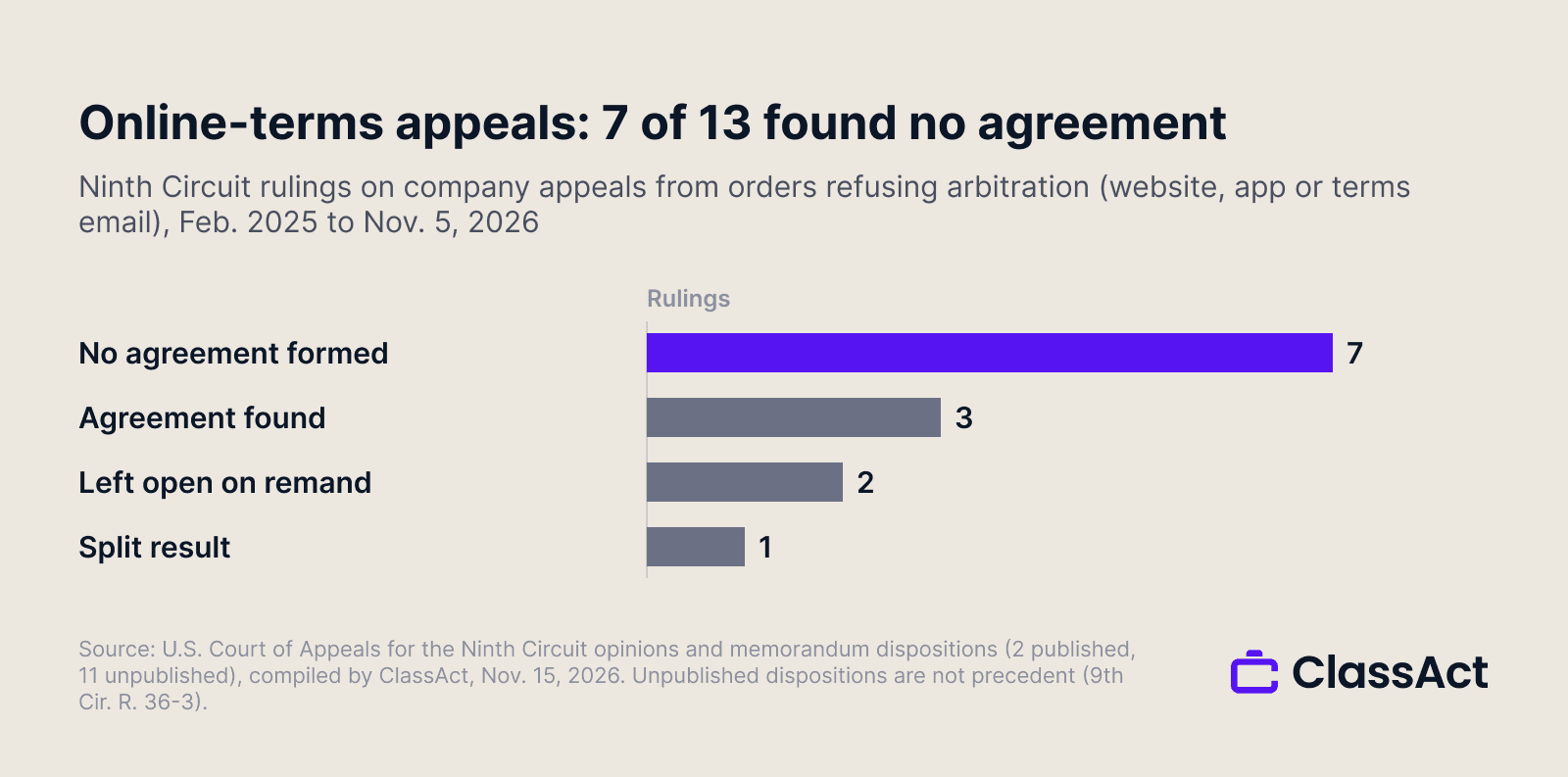
Sign-in wrap arbitration motions in the Ninth Circuit turn on two questions: whether the notice of the terms was hard to miss, and whether the page said exactly which click meant "I agree." We found 13 Ninth Circuit rulings, in 12 cases, from February 2025 through November 5, 2026 on company appeals from orders refusing to compel arbitration over online sign-ups, checkouts or terms emails. Seven ended with no agreement and three found one. One split, and two went back to the district court with formation still undecided.
- The Ninth Circuit asks whether the notice of terms was reasonably conspicuous and whether the consumer took an action the page explicitly said would mean agreement.
- In 13 Ninth Circuit rulings from February 2025 through November 5, 2026 on company appeals from orders refusing arbitration, 7 ended with no agreement, 3 found one, 1 split and 2 were remanded with formation undecided.
- A required checkbox next to a named agreement, and in one case an update email followed by app use from users who had accepted earlier terms, were enough to form an agreement.
- A denial can be appealed right away, and the district court must stay the case while the appeal is pending.
How does the Ninth Circuit decide sign-in wrap arbitration motions?
Whether a consumer agreed to arbitrate is a state contract law question. Courts "should apply ordinary state-law principles that govern the formation of contracts" (First Options of Chicago, Inc. v. Kaplan, 514 U.S. 938, 944 (1995)). Most rulings below applied California law. Rugs.com applied Washington law, and LendingTree applied Ninth Circuit case law after the parties agreed Washington, Texas and North Carolina law were the same.
In a sign-in wrap, the site "provides a link to terms of use and indicates that some action may bind the user but does not require that the user actually review those terms" (Chabolla v. ClassPass Inc., No. 23-15999, slip op. at 11 (9th Cir. Feb. 27, 2025)).
Unless the company shows the consumer actually knew of the terms, it must prove two things (Berman v. Freedom Financial Network, LLC, No. 20-16900, slip op. at 12 (9th Cir. Apr. 5, 2022)):
- Notice. The site gave "reasonably conspicuous notice of the terms to which the consumer will be bound."
- Assent. The consumer took an action, such as clicking a button or checking a box, "that unambiguously manifests his or her assent to those terms."
Under California law as the Ninth Circuit applies it, the second step is strict. A click counts "only if the user is explicitly advised that the act of clicking will constitute assent to the terms and conditions of an agreement" (Berman, slip op. at 14). "Even strongly implicit advisement isn't enough" (Godun v. JustAnswer LLC, No. 24-2095, slip op. at 17 (9th Cir. Apr. 15, 2025)). And the company "bears the burden of proving the existence of an agreement to arbitrate by a preponderance of the evidence" (Keebaugh v. Warner Bros. Entertainment Inc., No. 22-55982, slip op. at 12 (9th Cir. Apr. 26, 2024)).
The rule is contested inside the court. The judge who wrote Godun added a concurrence: "We got it wrong, the Second Circuit got it right." He also warned against carrying the rule "outside of California law" (slip op. at 29). Chabolla drew a dissent.
What did 13 Ninth Circuit rulings since February 2025 decide?
| Decided | Company (No.) | What the consumer did | Result | What decided it |
|---|---|---|---|---|
| Feb. 27, 2025 | ClassPass (23-15999), published | Four-page subscription sign-up | No agreement | First notice off the user's path in small gray text; "By signing up" over a "Continue" button |
| Apr. 15, 2025 | JustAnswer (24-2095), published | Paid trial sign-up | No agreement | Small notices away from the button; other versions of the payment page said "I agree" without naming the action |
| Aug. 18, 2025 | Yippee Entertainment (24-7235) | Streaming subscription | Left open | Reversed on notice (blue link right above "Start subscription"); assent sent back |
| Aug. 20, 2025 | Lands' End (25-328) | Checkout | No agreement | Terms link was broken and led to the Help Center |
| Aug. 26, 2025 | SuccessfulMatch.com (24-1870) | Dating site account | Agreement | Required "Agree" checkbox on an uncluttered screen |
| Oct. 20, 2025 | Trusper, dba Musely (24-6434) | Telehealth enrollment | No agreement | Clause sat in a second agreement behind a telehealth consent pop-up |
How we built it. We searched for Ninth Circuit decisions from February 2025 through November 15, 2026 (the latest is from November 5) on whether a consumer agreed to arbitrate online, and read each one. We left out employment cases and may have missed some memoranda.
Two caveats. First, 11 of the 13 are memoranda, which "are not precedent" under Ninth Circuit Rule 36-3(a), though they can be cited (Rule 36-3(b)). Second, every ruling was a company appealing an order that refused arbitration in whole or in part, because 9 U.S.C. § 16 allows those appeals right away but generally not appeals from an order "directing arbitration to proceed." So the figures show how the Ninth Circuit handled company appeals, not how often these motions succeed in district court.
Which sign-up designs failed, and which held up?
The failures fell into five patterns:
- The advisal names a different action than the button. ClassPass's second screen said "By signing up," but "the only button on screen 2 reads 'Continue'" (slip op. at 19). SimpliSafe's form said "[b]y submitting this number," but its button said "Next": "This mismatch of terms could easily confuse users" (memorandum at 6).
- The notice is easy to miss. LendingTree's tiny-font notice "seems to fade into the irrelevancy of other aspects of the page" (memorandum at 5, quoting Chabolla).
- There is no advisal. Rugs.com never said that clicking "Join Now" meant agreeing, so that click "cannot be construed as assent" (memorandum at 4).
- The link doesn't reach the terms. Lands' End conceded its link sent users to the Help Center.
- The clause is one document away. Musely linked a telehealth consent; the arbitration clause sat in a separate Participant Agreement.
The designs that held up tied a specific action to the terms. None of the three winners in our set was a plain sign-in wrap.
- A required checkbox next to the named agreement. Millionaire Match told users they "need[ed] to review and agree to the terms and conditions of both agreements and check the 'Agree' box" (memorandum at 4). University Credit Union's form "more closely resembles a 'clickwrap' agreement," a type courts "routinely" enforce (memorandum at 6).
- An update email, then continued use. The Tile consumers conceded they had accepted earlier terms. An "Updated Terms of Service and Privacy Policy" email, with a bold blue link, said continued use meant agreeing, and later app use bound them to the new terms (memorandum at 3, 11 to 12). The panel did "not hold that notice by mass email establishes inquiry notice in every case" (memorandum at 10).
- A plain advisal at the button. Outside our set, Keebaugh shows a sign-in wrap that passed: a mobile game screen said "By tapping 'Play,' I agree to the Terms of Service" (slip op. at 14, 27).
What evidence decides whether a consumer agreed?
Screenshots, declarations and company records. If "the making of the arbitration agreement" is disputed, the court "shall proceed summarily to the trial thereof," and the party resisting arbitration can demand a jury on or before the return day of the notice of application (9 U.S.C. § 4).
- Target and Shipt. The consumer's screenshot showed a $6.49 "CA Shipt Shopper Benefits Fee," but his complaint alleged a $3.99 fee, so it "unquestionably does not depict the underlying purchase" (memorandum at 3). His "I do not recall" statements were "equivocal." The panel also upheld the refusal to consider sign-in evidence Target first filed with its reply (memorandum at 2 to 4).
What happens after a court refuses to compel arbitration?
The company can appeal right away under 9 U.S.C. § 16(a)(1)(B). In Coinbase, Inc. v. Bielski, 599 U.S. 736 (2023), the Supreme Court held 5 to 4 that "[t]he district court must stay its proceedings" during that appeal (slip op. at 1).
The Yippee case shows the cost. The first appeal, decided August 18, 2025, reversed on notice and sent the assent question back. The second, decided November 5, 2026, affirmed that no agreement formed. Two trips to the Ninth Circuit, about 15 months apart, over whether there was a contract at all.
What this means for your firm
| Question to ask at intake | Why it can matter | Ruling it comes from |
|---|---|---|
| Did you buy or sign up on a website, in an app, or as a guest? | Courts look at the exact screens the person used | Keebaugh; Target and Shipt |
| Roughly when did you sign up, and when was the purchase at issue? | Screens and terms change; the version in effect then is what counts | Target and Shipt; Tile |
| Did you check a box or click a button labeled "Agree"? | Checkbox-and-Agree flows were enforced | SuccessfulMatch.com; University Credit Union |
| Do you usually stay signed in? | Someone who stays signed in may never see the sign-in screen | Target and Shipt |
| Did you get emails about updated terms, and have you used the app since? | An update email plus continued use bound users to new terms in one case | Tile |
| Do you have screenshots, receipts or confirmation emails from that transaction? | A screenshot that doesn't match the transaction can't settle the question | Target and Shipt |
Practice points:
- Read the advisal against the button. Record the exact advisal and button label on each screen. Mismatches decided ClassPass, SimpliSafe and the second Yippee appeal.
- Vet each sign-up path. Class members with the same claim can face different arbitration arguments depending on how each signed up. Our post on vetting class representatives covers the other facts courts check.
- Know the other road. Where the terms likely bind, claims may go to individual arbitration. Our breakdown of mass arbitration fees covers that path.
Rules vary by jurisdiction. Check the rules that apply to you.
FAQ
An online contract where the site links to its terms and says that some action, such as signing up, binds the user, without making the user open the terms. It sits between a clickwrap, where users must click an "I agree" box, and a browsewrap, where the site treats merely using it as agreement.
Sometimes. In the Ninth Circuit the company must show reasonably conspicuous notice of the terms and an action the page explicitly tied to agreeing. A mobile game screen that said "By tapping 'Play,' I agree to the Terms of Service" passed in Keebaugh (2024). Sign-ups whose advisals did not match their buttons have failed, including ClassPass's in 2025.
The party seeking arbitration. In the Ninth Circuit it must prove an agreement to arbitrate by a preponderance of the evidence. If there is a genuine dispute of material fact, such as which checkout screen a consumer saw, the court must hold a trial on that question, and the party resisting arbitration can demand a jury.
Sources
- 9 U.S.C. § 4, Failure to arbitrate under agreement (Cornell LII), text checked November 15, 2026
- 9 U.S.C. § 16, Appeals (Cornell LII), text checked November 15, 2026
- First Options of Chicago, Inc. v. Kaplan, 514 U.S. 938 (May 22, 1995), U.S. Reports (Library of Congress)
- Coinbase, Inc. v. Bielski, No. 22-105, slip opinion (U.S. June 23, 2023)
- Ninth Circuit Rules, Circuit Rule 36-3 and FRAP 32.1 (rules edition of June 1, 2026)
- Berman v. Freedom Financial Network, LLC, 30 F.4th 849, No. 20-16900 (9th Cir. Apr. 5, 2022)
- Keebaugh v. Warner Bros. Entertainment Inc., 100 F.4th 1005, No. 22-55982 (9th Cir. Apr. 26, 2024)
- Chabolla v. ClassPass Inc., 129 F.4th 1147, No. 23-15999 (9th Cir. Feb. 27, 2025)
- Godun v. JustAnswer LLC, 135 F.4th 699, No. 24-2095 (9th Cir. Apr. 15, 2025)
- Memorandum, No. 24-7235 (9th Cir. Aug. 18, 2025) (Yippee Entertainment, Inc.)
- Memorandum, No. 25-328 (9th Cir. Aug. 20, 2025) (Lands' End, Inc.)
- Memorandum, No. 24-1870 (9th Cir. Aug. 26, 2025) (SuccessfulMatch.com, dba Millionaire Match)
- Memorandum, No. 24-6434 (9th Cir. Oct. 20, 2025) (Trusper Inc., dba Musely)
- Memorandum, No. 25-2207 (9th Cir. Dec. 30, 2025) (University Credit Union)
- Memorandum, No. 25-403 (9th Cir. Mar. 3, 2026) (Tile, Inc. and Life360 Inc.)
- Memorandum, No. 25-4061 (9th Cir. Aug. 14, 2026) (Target Corporation and Shipt, Inc.)
- Memorandum, No. 25-4933 (9th Cir. Aug. 31, 2026) (SimpliSafe, Inc.)
- Memorandum, No. 25-4155 (9th Cir. Oct. 28, 2026) (Rugs.com, LLC)
- Memorandum, No. 25-7045 (9th Cir. Nov. 4, 2026) (LendingTree, LLC and QuoteWizard.com, LLC)
- Memorandum, No. 25-7161 (9th Cir. Nov. 5, 2026) (Yippee Entertainment, Inc.)
ClassAct is a technology platform, not a law firm. This post is general information, not legal advice. Rules vary by jurisdiction. Check the rules that apply to you.